Prahitha Movva
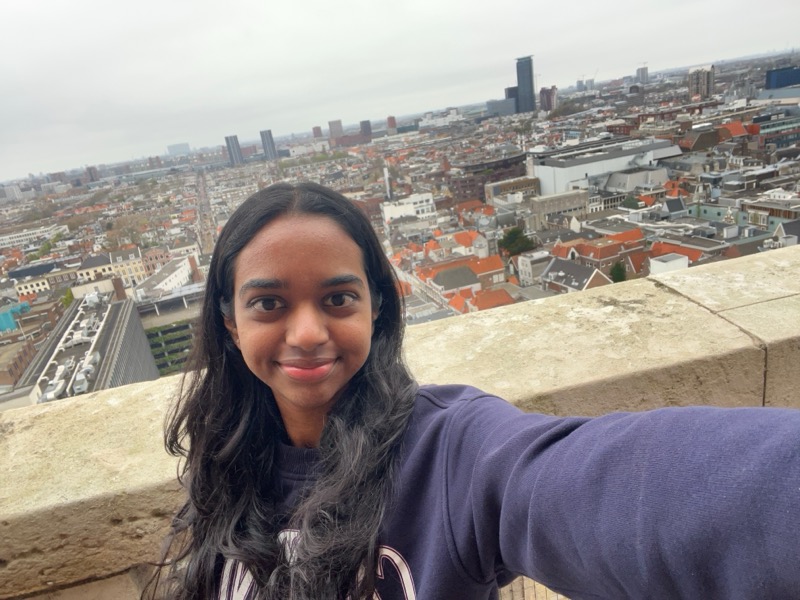
Hello, I’m Prahitha.
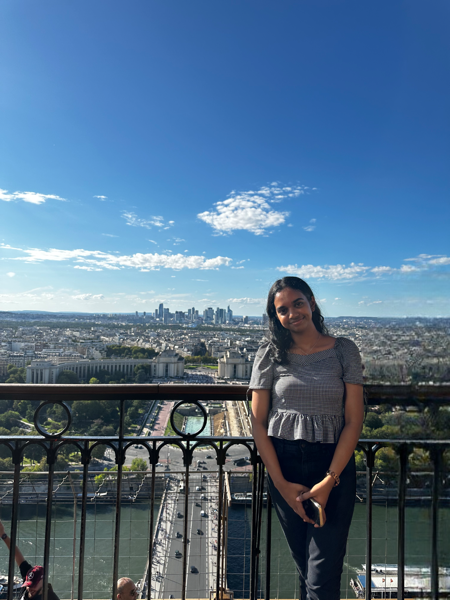
A photograph from Paris
Paris.
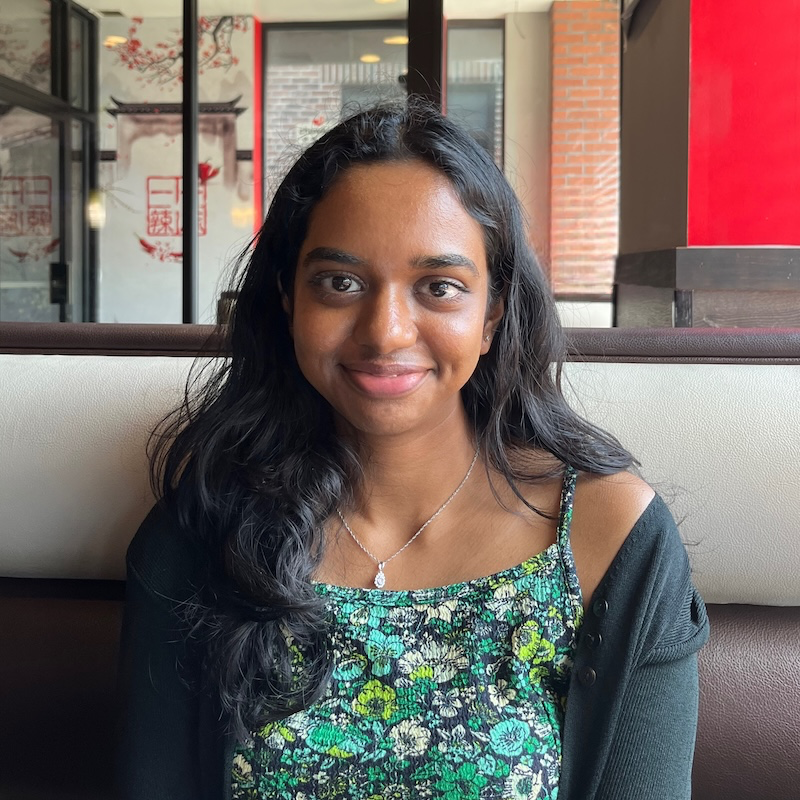
A travel photograph
Along the way.

Hi — I’m Prahitha. Beth, if we’ve met.

Prahitha Movva

AI researcher · I study evaluation — when vision-language models actually reason, and when they don’t.

I’m an early-career AI researcher, based in Germany. Most recently a Research Engineer Intern at Predii, where I built extraction pipelines for warranty PDFs and an LLM-as-a-judge evaluation microservice. Before that, my MS in Computer Science at UMass Amherst.

My work is about Also: contamination-resistant benchmarks, and checking a model can be trusted before it ships.Reasoning Riddles, COLM 2025 → — diagnostic methods that surface where vision-language models actually reason and where they only pattern-match.

The instinct comes from years in .Capture-the-flag. Wins at COMPFEST, Pragyan, RESTCON and Shakti — where I learned never to trust a system's intended story. Careful thinking is only half of it, though — I also lead the ML Industry Program at Cohere Labs, mentor at hackathons, and care a lot about .The thread under the mentoring, the LevelUp Labs talks, and the DSSG work for UNICEF.Advice for students →

Now looking toward PhD programs (Fall 2027) and research engineer roles. This site is a small museum: the work I’ve kept, and the things I noticed along the way.

what I’m up to currently
  • readinga stack of papers on data contamination (and one novel, finally)
  • curious abouteducational equity, and what good evaluation looks like outside of ML
  • relearningTelugu poetry — slowly, with help
  • baking[what came out of the oven this month]draft

as of September 2026

News

there's a flag hidden on this site. CTF habits die hard.

  1. workfresh out of the oven

    Wrapped up my Research Engineer Internship at Predii — extraction pipeline and an LLM-as-a-judge eval microservice for warranty PDFs.

  2. paper

    Enginuity accepted as Oral at the NeurIPS 2025 AI4Science Workshop ($2000 grant, Top 5).

  3. talk

    Presented Reasoning Riddles at the COLM 2025 XLLM-Reason-Plan Workshop in Montreal — travel supported by the COLM DEI Scholarship.

  4. paper

    Enhancing Scientific VQA accepted at the ACL 2025 SDP Workshop.

  5. service

    Reviewer for NeurIPS, COLM, and ICCV 2025 — Ethics, AI4Science, Math-AI, XLLM-Reason-Plan, and LIMIT workshops.

  6. milestone

    Finished my MS in Computer Science at UMass Amherst (3.84/4.0).

Selected research

peer-reviewed, taste-tested

Enginuity: Building an Open Multi-Domain Dataset of Complex Engineering Diagrams Oral$2k Grant

E. Seefried, N. H. Marupaka, P. Movva, T. Kasturi, T. Ghosal

NeurIPS 2025 AI4Science Workshop

An open, multi-domain dataset of complex engineering diagrams built to push multimodal reasoning. Selected as Oral (Top 5) and awarded a $2000 grant from Renaissance Philanthropy.

Keywords: multimodal, dataset

We propose Enginuity — the first open, large-scale, multi-domain engineering diagram dataset with comprehensive structural annotations designed for automated diagram parsing. By capturing hierarchical component relationships, connections, and semantic elements across diverse engineering domains, our proposed dataset would enable multimodal large language models to address critical downstream tasks including structured diagram parsing, cross-modal information retrieval, and AI-assisted engineering simulation. Enginuity would be transformative for AI for Scientific Discovery by enabling artificial intelligence systems to comprehend and manipulate the visual-structural knowledge embedded in engineering diagrams, breaking down a fundamental barrier that currently prevents AI from fully participating in scientific workflows where diagram interpretation, technical drawing analysis, and visual reasoning are essential for hypothesis generation, experimental design, and discovery.

@inproceedings{seefried2025enginuity,
  title={Enginuity: Building an Open Multi-Domain Dataset of Complex Engineering Diagrams},
  author={Seefried, Ethan and Marupaka, Naga Harshita and Movva, Prahitha and Kasturi, Tilak and Ghosal, Tirthankar},
  booktitle={NeurIPS 2025 AI4Science Workshop},
  year={2025}
}

Reasoning Riddles: How Explainability Reveals Cognitive Limits in Vision-Language Models Workshop

P. Movva

COLM 2025 XLLM-Reason-Plan Workshop

Using explainability to surface where vision-language models actually reason — and where they're only pattern-matching through visual surface cues.

Keywords: multimodal, evaluation, explainability

We investigate how explainability methods can reveal whether vision-language models are genuinely reasoning or relying on spurious surface cues. Through a series of controlled riddle tasks, we show that standard VLMs often fail when explanations are required, exposing cognitive limits in their reasoning capabilities.

@inproceedings{movva2025reasoning,
  title={Reasoning Riddles: How Explainability Reveals Cognitive Limits in Vision-Language Models},
  author={Movva, Prahitha},
  booktitle={COLM 2025 XLLM-Reason-Plan Workshop},
  year={2025}
}

All research & publications →

I like talking to people about what they’re working on. Find half an hour, or see what else I get up to.